




George Frederick Watts
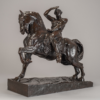
Physical Energy
After George Frederic Watts (1817-1904)
Physical Energy
Inscribed Physical Energy, G.F. Watts
Height: 18.5″ (47 cm)
ABOUT THE ARTWORK
George Frederic Watts is best known as a painter, yet his achievements as a sculptor are equally significant. His first major sculptural work, Clytie of 1868, already revealed his ambition: a classical subject transformed into a dynamic, emotionally charged bust, twisting through its axis with a distinctly Romantic sensibility.
The origins of Physical Energy lie in Watts’s earlier equestrian figure of Hugh Lupus, commissioned by the Duke of Westminster for Eaton Hall in Cheshire. Watts later developed this idea into one of his most important sculptural inventions. The first heroic version of Physical Energy was modelled in the grounds of New Little Holland House, now 6 Melbury Road, and was cast in bronze in 1904 and erected in the Rhodes Memorial in Cape Town in 1912.
The sculpture was intended to embody drive, ambition, and heroic force. it became the central image of a broader Victorian and Edwardian ideal of national confidence, exploration, and expansion. The monument remains one of the most imposing public sculptural ensembles of the period. It is further distinguished by the inclusion of monumental lions originally created for Trafalgar square by Sir Edwin Landseer, reinforcing its connection to British public sculpture and national identity. Physical Energy was exhibited in the courtyard at Burlington House for the Royal Academy Summer Exhibition in 1904, the year of Watts’s death.
 Rhodes Memorial, Cape Town
 George Frederick Watts, Physical Energy, 1904 cast, Rhodes Memorial Cape Town
Watts continued working on the composition after the first cast was made, reworking the model of Physical Energy with the assistance of Thomas Wren. This second version, cast for Kensington Gardens and erected in 1907, has a more heavily textured and almost hammered surface. This treatment reflects the changing artistic climate of the early twentieth century, with a greater interest in stylisation associated with modernism.
 George Frederick Watts and Thomas Wren, Physical Energy, 1907 cast, Kensington Gardens
 Detail of mid-section of Rhodes Memorial, 1904 cast
 Detail of mid-section of Physical Energy in Hyde Park, 1907 cast
Watts also produced a small version of Physical Energy for the collector market. Crucially, there are two distinct small editions. The first, produced in only eight examples, is based on the original model used for the Rhodes Memorial and is simply inscribed Physical Energy and signed G.F. Watts. This version was modelled entirely by Watts himself. The later small edition, dated 1914, relates to the revised Kensington Gardens version and bears the signature of Thomas Wren alongside that of Watts. It also shows the rougher, reworked surface associated with the later public monument.
 Illustration of the current example.
 Illustration of later cast with re worked surface signed G.F.Watts and T.H.Wren and dated 1914.
 Detailed shot of mid section of earlier original, small version, Inscribed Physical Energy and signed G.F. Watts
 Detailed shot of mid section of later, small version showing hammered surface made in collaboration with Thomas Wren, signed and dated G.F.Watts and T.H. Wren 1914.
The present example belongs to the earlier and rarer group. Its smoother modelling and simpler surface treatment connect it directly with Watts’s original conception for the Rhodes Memorial, before Wren’s later intervention. This distinction is highly important: the work is not only earlier, but represents Watts’s own sculptural vision. This discovery significantly enhances the importance of the present bronze. As an early, rare, Watts-modelled version of one of the artist’s most celebrated public sculptures, it offers a remarkable opportunity to acquire a major work by one of the most important British artists of the nineteenth century. Another cast is in the Liverpool Museum, Liverpool.


 English
  Chinese