


Tiger and Gavial
Signed Barye and dated 1837
Bronze with rich golden brown and mid brown patina
Height: 8.66″ (22 cm)
Length: 21.25″ (54 cm)
Provenance:
Private Collection France
ABOUT THE ARTWORK
Antoine-Louis Barye was the undisputed master of the Animalier School of sculpture in the 19th Century. Breaking away from the establishment, he modelled animals with the same sincerity usually afforded to the human subject. Although Barye is best known for his sculpting of animals, he did not limit himself exclusively to this subject. He was one of the great masters of Romantic sculpture along with David d’Angers and Rude.
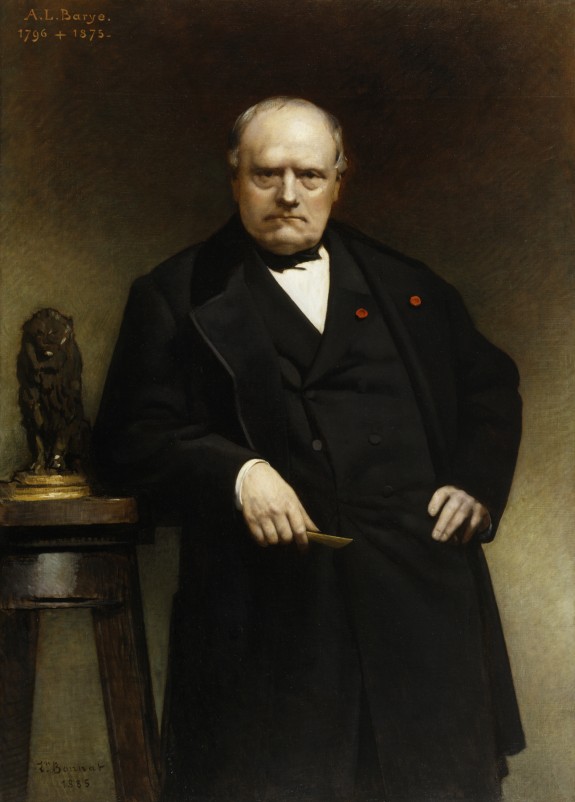 L. Bonnat, Portrait of Antoine-Louis Barye with a wax model of “Seated lion”, 1885, oil on canvas, Walters Art Gallery
The son of a Lyonnaise goldsmith, Barye started work at the age of thirteen as an apprentice to a metal engraver in the workshop of Martin Guillaume Biennais, Napoleon’s master goldsmith. There, the young artist observed the most sophisticated technical practices current among Parisian goldsmiths, encountering neo-classical and antique models, which would prove to influence his work in the years to come.
He later studied under the neo-classical sculptor Bosio and the romantic painter Gros. This combination of influences led Barye to develop his unique style and technique of the sort later associated with the Barbizon School of painters. By the time he left the Ecole des Beaux-Arts – where he studied from 1818 to 1823 – he was well-versed in a wide range of artistic sources, from antiquity through Renaissance and Baroque to the neo-classical.
In 1823 Barye went to work for the goldsmith Fauconnier modelling small decorative pieces taken from live drawings of animals at the Jardin des Plantes.
His desire to present the anatomy of his subjects led him to study preserved skeletons of animals, as well as attend dissections.
At the Salon of 1831, Barye exhibited his Tiger devouring a Gavial. This work established his artistic reputation with its powerful lines and brutal subject matter, fuelling lively discussions amongst contemporary critics on the beauty of nature even when presented in its cruellest form. When a plaster model for this sculpture appeared in the Paris Salon of 1831, critics were astonished by the choice of an animal theme over a more conventional human subject. The critic Etienne-Jean Delecluze described the work as ‘the strongest and most significant work of the entire Salon’, while Théophile Gautier commented, ‘what energy, what ferocity, what a thrill of satisfied lust for killing shows in the flattened ears, the savage gleaming eyes, the curved nervous back, the clutching paws, the rocking haunches, and the writhing tail of the tiger, and how the poor scaly monster doubles in agony under those cutting teeth and jaws.’
He became a favourite of the Royal House of Orleans, displaying a bust of the Duke and his Lion Crushing a Serpent in the Paris Salon of 1833; the latter model was acquired by the State and placed in the Tuileries Gardens in 1835.
In 1845 he formed a company with the entrepreneur Emile Martin and two years later, in 1847, produced his first catalogue, counting over 100 works. Public commissions also followed, including eight reliefs for the Jena Bridge and 97 masks for the Pont Neuf. In 1848 Barye was appointed curator of the gallery of plaster casts at the Louvre. He taught extensively, working at the Agriculture School at Versailles and the Musee d’Histoire Naturelle, wherein 1863 one of his pupils was the young Auguste Rodin.
Barye died in 1875 and was buried in the Père Lachaise Cemetery in Paris. His sculptural legacy lives on, disseminated in some of the most prestigious museums of the western world.
Museum Collections
Metropolitan Museum, New York, Tiger and Gavial (inv. no. 10.108.2).
Detroit Institute of Arts, Detroit, Tiger and Gavial,
Musée du Louvre, Tiger and Gavial (inv. no. OA 5754)


 English
  Chinese