
Sir George James Frampton was born in London in 1860, the son of James Frampton – a wood and stone carver. At the age of 18, confident of the experience gained in his father’s workshop, the artist moved to Paris to work on the building site of the Hôtel de Ville. He returned to London shortly after, studying at the Lambeth School of Art under W.S. Frith and then at the Royal Academy from 1881 to 1887.
Sir George James Frampton was born in London in 1860, the son of James Frampton – a wood and stone carver. At the age of 18, confident of the experience gained in his father’s workshop, the artist moved to Paris to work on the building site of the Hôtel de Ville. He returned to London shortly after, studying at the Lambeth School of Art under W.S. Frith and then at the Royal Academy from 1881 to 1887.
Having exhibited at the RA for the first time in 1884, Frampton went on to win a gold medal and a travelling scholarship in 1887. Part of his travels took him to Paris, where he enrolled in the studio of one of the most successful sculptors in France, Antonin Mercié (1845-1916).
Mercié’s work had been the inspiration for many of the English ‘New’ sculptors, particularly for the early work of Alfred Gilbert. During Frampton’s apprenticeship, Mercié was instrumental in introducing the artist to the French Romantic movement, as well as to the intricacies of Symbolism, which were to become a key feature of the artist’s later work.
Upon his return to England, Frampton became the leader of the Arts and Crafts movement and was appointed joint head of the London Central School of Art, a post he led throughout the 1890s. His mastery of mixed media sculpture is best shown by his polychromed plaster of Mysteriarch of 1892, now part of the Walker Art Gallery collection, in Liverpool. The sculpture is representative of Frampton’s mature, Symbolist aesthetic: never before that time in Britain had a bust been so filled with evocative power and devoid of its traditional function as a portrait. Frampton’s contribution to the movement was not limited to the United Kingdom, as the artist participated in the first show of the Symbolist group La Libre Esthétique in Brussels in 1894.
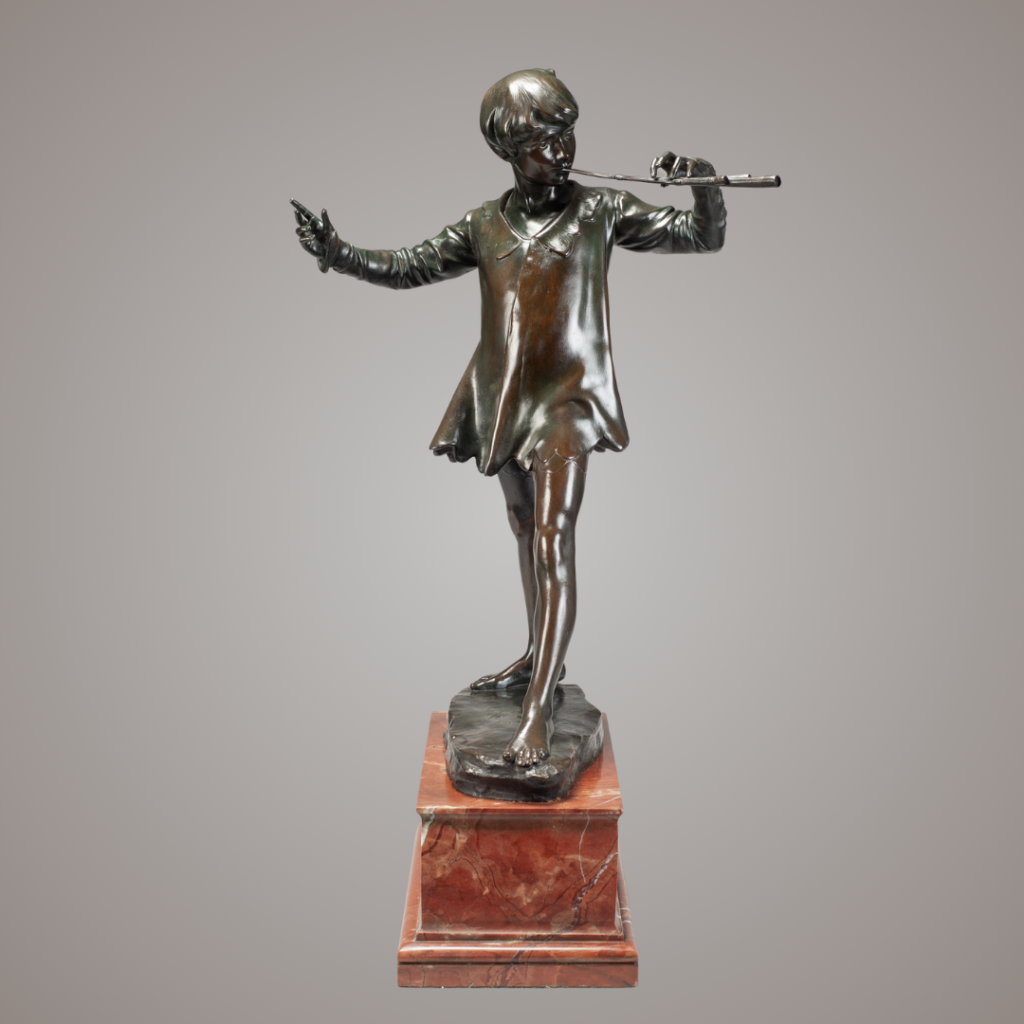
Frampton is however best known for his statue of Peter Pan in Kensington Gardens. Commissioned by the character’s creator Sir James Matthew Barrie (1860-1907). This was erected in 1912 at night so that the public might think it appeared by magic. Other casts of the sculpture occupy prominent public locations in Liverpool, Brussels, Camden (New Jersey), Toronto (Ontario), St John’s (Newfoundland) and Perth (Western Australia).
Frampton was knighted in 1908, marking the importance of his contribution to the development of English sculpture in the late Victorian and Edwardian period.


 English
  Chinese