
Massimiliano Pelletti (Born. 1975) is an Italian stone carver who lives and works in Pietrasanta, Italy, a hometown he shares with Michelangelo. Pelletti initially began his journey as a sculptor in his family’s artisan workshop and was inspired and taught by his grandfather, a sculptor in his own right and who, in his time, worked on the infamous restoration of Michelangelo’s Pietà in The Vatican. Many of Massimiliano’s sculptures are inspired by the collection of plaster classical models inherited from his grandfather’s Glyptotheque.



Massimiliano Pelletti (Born. 1975) is an Italian stone carver who lives and works in Pietrasanta, Italy, a hometown he shares with Michelangelo. Pelletti initially began his journey as a sculptor in his family’s artisan workshop and was inspired and taught by his grandfather, a sculptor in his own right and who, in his time, worked on the infamous restoration of Michelangelo’s Pietà in The Vatican. Many of Massimiliano’s sculptures are inspired by the collection of plaster classical models inherited from his grandfather’s Glyptotheque.
 Massimiliano Pelletti
“My grandfather taught me to be humble, to fill the work with poetry and to face problems by transforming them into resources. Thanks to these teachings, in my work every defect has turned into merit.”
 Mario Pelletti, Massimiliano’s Grandfather, in his studio
After obtaining his diploma from the Stagio Stagi Art School in Pietrasanta, he went on to graduate from the University of Pisa with a degree in Philosophy. He made his artistic debut in 2006, winning the 12th edition of the Biennale of Young Artists from Europe and the Mediterranean, followed by a series of other prestigious exhibitions, both in Italy and abroad, such as the Alexandria Biennale in Egypt and the 54th Venice Biennale as part of the Italian Pavilion, curated by Vittorio Sgarbi.
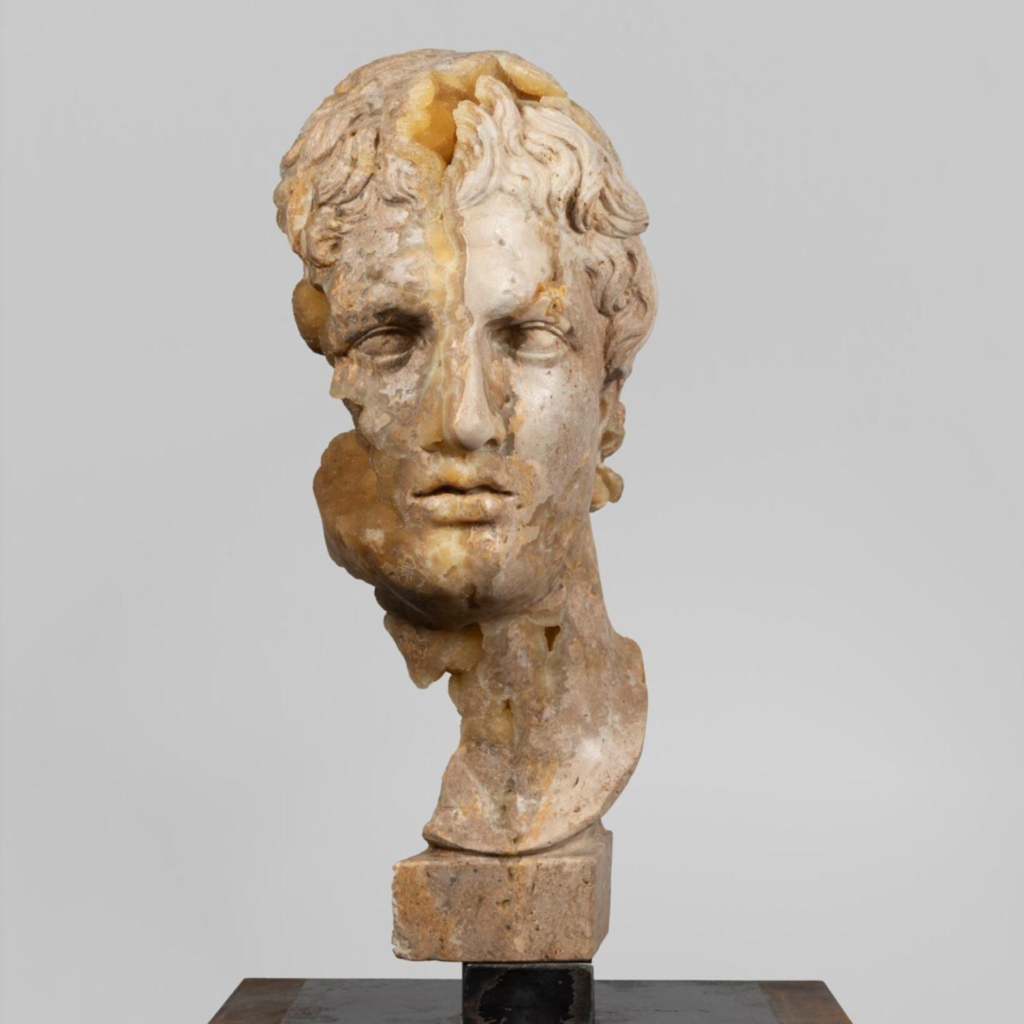
On initial inspection, Pelletti’s sculptures resemble those triumphant figures from antiquity, however, they are decidedly not. Massimiliano’s sculptures are not only hewed from the marble quarries of Pietrasanta, opened under the Medici government, but are instead carved from rough, porous, or unusual stones, with colourful striations and crystalline fissures which interrupt their beautiful faces and distort their otherwise idealised torsos.
Pelletti gravitates toward imperfection and his approach revolves around transforming presumed defects, impurities, cracks, or chips into elegantly carved figures from antiquity. Through this practice, Pelletti considers the tensions between the careful craftsmanship of ancient sculpture traditions and the unformulated chaos of the natural world.
“In antiquity, classicism represented the divine perfection and also man’s ambition to rise to that perfection. In my work, I simply made this ambition more earthly, closer to us, to the contemporary man, with all its defects and its fragilities.”
 Massimiliano Pelletti, Emerald Minerva, Green Onyx, 77 cm
The artist’s work combines the past with the present, contrasting smooth segments with the rough texture of unpolished stone. Natural stones and materials are selected to compliment his subject matter and their natural flaws and fissures serve as the unusual focal point of his work.
“I’m not a sculptor who imposes himself on the material and transforms it according to his desire, I’m a sculptor, an artist who seeks a collaborative relationship, who seeks an intimate dialogue with the matter and tries to draw out a result that respects”
Pelletti selects his materials based on the quality and intrigue of the stone type. While some stones are chosen for their crystalline structure and opaque qualities, others are selected for more unusual reasons. Pelletti favours some stones such as quartz and obsidian for their particular energies, thought to have specific healing qualities that can benefit the mind, body and soul while other rarer works are carved from black marble with prehistoric sea life fossils known as Orthoceras.
 Massimiliano Pelletti, Heracles, Onyx and Breccia Medicea
In 2014, he was among the winners of the Henraux Foundation International Sculpture Award, curated by Philippe Daverio. He has published several articles in magazines devoted to contemporary art and, over the years, has shown his works in several museums and public areas such as the Villa Croce and Sant’Agostino in Genoa, the Abbey of San Zeno in Pisa, the Temple of Hadrian in Rome, Castel Sant’Elmo in Naples, Sapienza University in Rome, the Contemporary Art Museum Luigi Pecci in Prato, the Paolo Giovio Civic Museum in Como, Palazzo RISO Museo d’Arte Contemporanea della Sicilia in Palermo and the Jewish Museum of Bologna.
In recent years Pelletti has completed several important public commissions including a 5-meter-high monumental work in Carrara white marble for a new urban project in Acapulco, Mexico, and a prestigious public commission for a monumental sculpture in Forte dei Marmi, Italy. His recent solo exhibitions include ‘Looking Forward to the Past’ at the MARCA in Catanzaro and ‘Gazing of Tranquility’ at the Zhejiang Art Museum in Shanghai which later travelled to the Wuhan Art Museum and the Guangdong Museum of Art in China. In 2021 his works were displayed alongside those of Canova in an exhibition called ‘Canova. Between Innocence and Sin’ curated by Beatrice Avanzi and Denis Isaia.
Bowman Sculpture took on the exclusive UK representation of Pelletti in 2023, marked by a sell-out exhibition titled ‘Eredità’ (11th October – 10th November 2023), curated by Mica Bowman. Since introducing his work to the UK market, it has been of interest to museum collections, curators and private clients alike.
Most recently, Pelletti’s work was exhibited at the Palazzo Massimo National Roman Museum in a show titled ‘Versus’, from October 2024 to January 2025, where he was invited to display his sculpture in dialogue with the iconic classical pieces on display such as the Lancellotti Discobolus and Crouching Venus. He is the first contemporary artist to be given this honour, which stands as a testament to not only the skill, but also the cultural significance of his work.
 ‘Versus’ exhibition, Palazzo Massimo National Roman Museum, 2024-2025


 English
  Chinese