
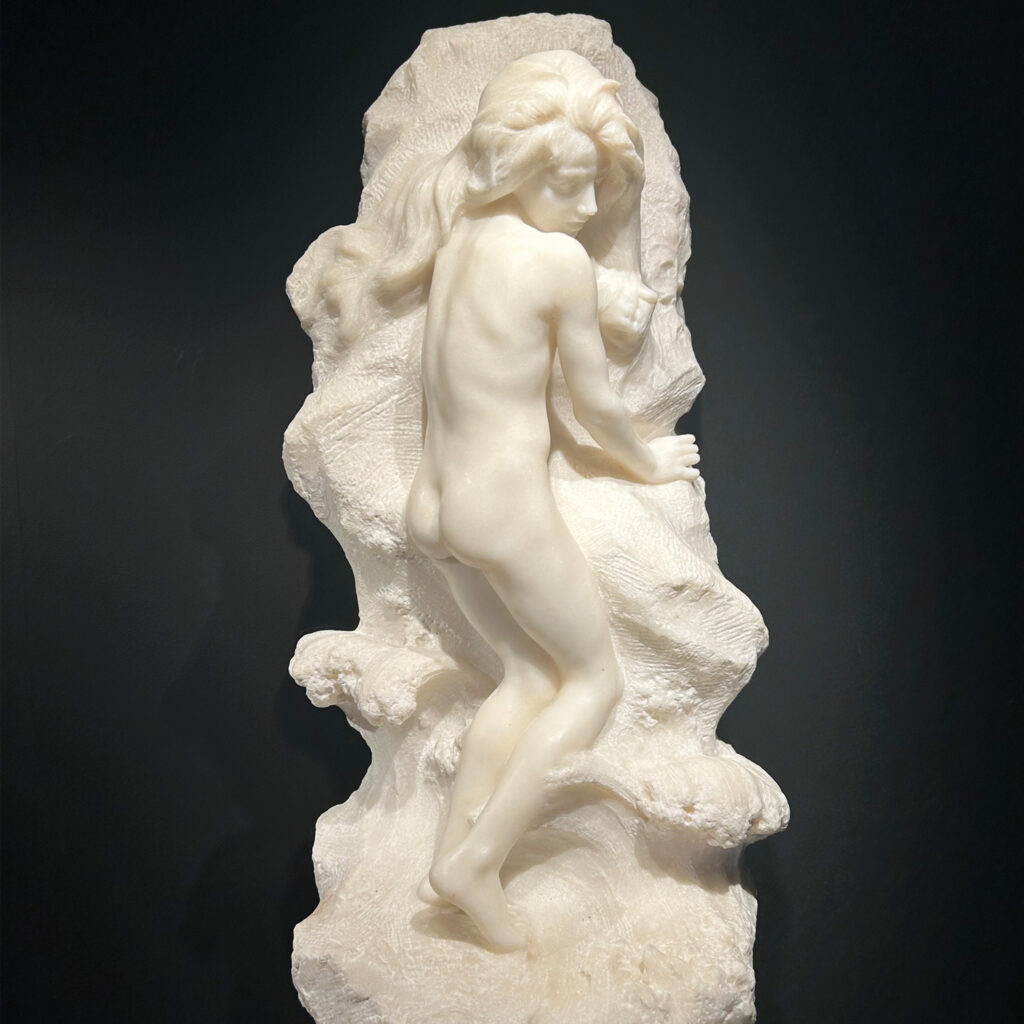
Born in Tarbes in the hills of the Pyrenées, on 20th November 1853, Louis Mathet gained his initial experience working in the studio of the influential sculptor Augustin Dumont in Paris. Mathet submitted work to the Paris Salon for several years before having a work selected for exhibition, making his debut in 1884. An honourable mention followed at the Salon of 1887, the same year that the Societaire des Artistes Francais awarded him full membership. He was awarded a third class medal at the salon in 1889 and a silver medal at the Exposition Universelle of 1900.
Whilst in Paris, Mathet came under the influential spell of Auguste Rodin, visiting his studio and attending his exhibitions. The influence of the master can clearly be seen in Mathet’s work between 1900 and 1914. Not only are his sculptural forms softened and flowing but they often appear to emerge from the blocks of rough-hewn marble, characteristic of many of Rodin’s marble sculptures.
Mathet was an extremely versatile sculptor and his subjects varied enormously. His Salon entries encompassed mythological figures, nymphs and whimsical allegories as well as formal portrait busts. Such was the interest in his work exhibited at the Salon that he received many commissions from both private buyers, as well as the State.

 English
  Chinese