
Arnaldo Pomodoro was born in Morciano di Romagna and is one of the most internationally renowned Italian postwar sculptors. He is celebrated for his bronze sculptures, which merge geometric volumes with intricate inner structures. His early artistic practice, derived from his gold smithing background, which he adapted to create reliefs engraved with illegible glyphs, was inspired by ancient cuneiform writing systems. In 1954, Pomodoro relocated to Milan, where he joined an artistic circle of avant-garde artists, including Lucio Fontana (1899-1968), who greatly influenced his practice and contributed to his artistic development.
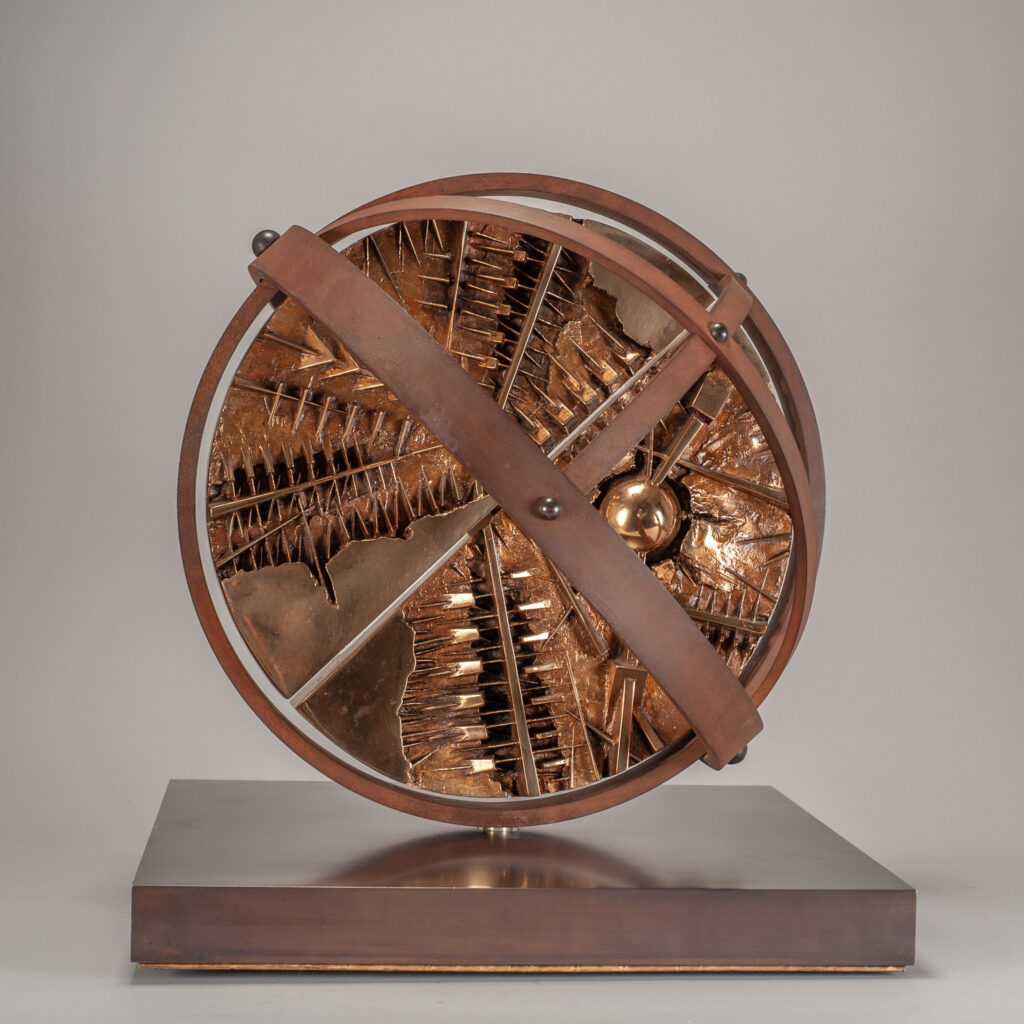
Arnaldo Pomodoro was born in Morciano di Romagna and is one of the most internationally renowned Italian postwar sculptors. He is celebrated for his bronze sculptures, which merge geometric volumes with intricate inner structures. His early artistic practice, derived from his gold smithing background, which he adapted to create reliefs engraved with illegible glyphs, was inspired by ancient cuneiform writing systems. In 1954, Pomodoro relocated to Milan, where he joined an artistic circle of avant-garde artists, including Lucio Fontana (1899-1968), who greatly influenced his practice and contributed to his artistic development.
In the early 1960s, Pomodoro was a member of the group Continuità which was promoted by the notable critic and curator Giulio Carlo Argan (1909–1992). During this period, Pomodoro developed his signature style by creating polished bronze sculptures of excavated and corroded geometric forms, such as spheres and discs.
Monumental examples of Pomodoro’s Sfera con Sfera (Sphere Within a Sphere) series, can be found in leading institutional collections, including the Vatican Museums, the United Nations in New York, the Paris headquarters of UNESCO, and Trinity College, Dublin. His unique sculptural language evokes a counterposition between perfection and disruption, surface and depth, modernity and ancient memory.
The Pomodoro foundation in Milan, established in 1995, preserves his legacy, keeping accurate records of his works and ensuring his relevance for future generations.

 English
  Chinese