
William Turnbull was one of the most influential modern British sculptors. Born in Dundee, Scotland, in 1922, he initially worked as a pilot in the RAF in 1941 and later turned down a lucrative offer to become a commercial pilot in order to pursue his artistic career. In 1946, he enrolled at the Slade School of Fine Art. Over the course of his career, Turnbull worked in a variety of materials, including plaster, bronze, wood, steel and plastic. His early work took inspiration from the sculpture of ancient Greece, West Africa and South-East Asia. His work often incorporated several elements in contrasting traditional materials, such as bronze, stone and wood.
William Turnbull was one of the most influential modern British sculptors. Born in Dundee, Scotland, Turnbull joined the Royal Air Force in 1941, serving as a pilot. Turnbull studied at the Slade School of Fine Art in London between 1946 and 1948 and then spent two years living in Paris, where he met Brancusi and Giacometti.
On his return to London Turnbull had his first one-man exhibition at the Hanover Gallery, London in 1950. In 1952 he represented Britain in a group exhibition at the Venice Biennale.
In 1973, a retrospective exhibition of his work was held at the Tate Gallery, London, and in 1982 he took part in British Sculpture in the Twentieth Century at the Whitechapel Art Gallery, London.
A retrospective of his work was held at the Serpentine Gallery, London in 1995–96. Major solo exhibitions were held at The Yorkshire Sculpture Park in 2005 and at the Tate Britain in 2006.
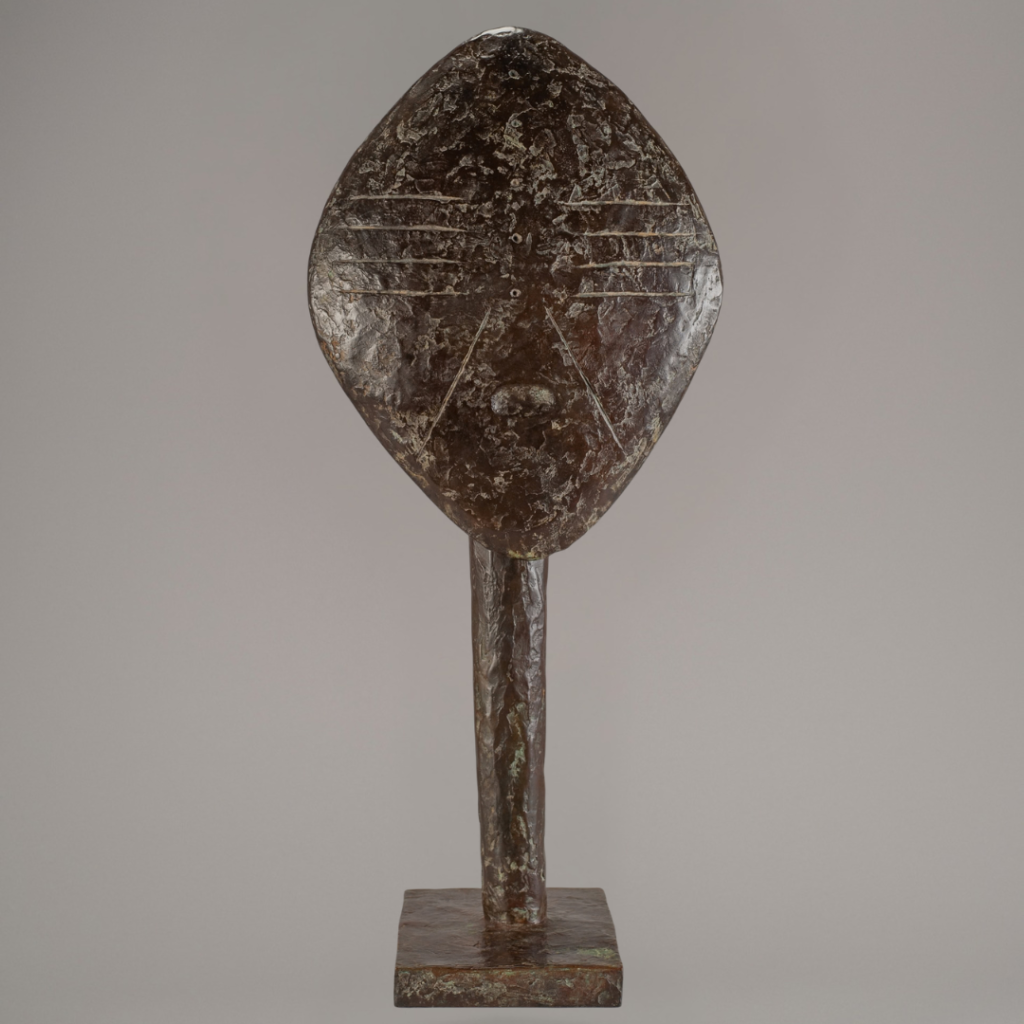
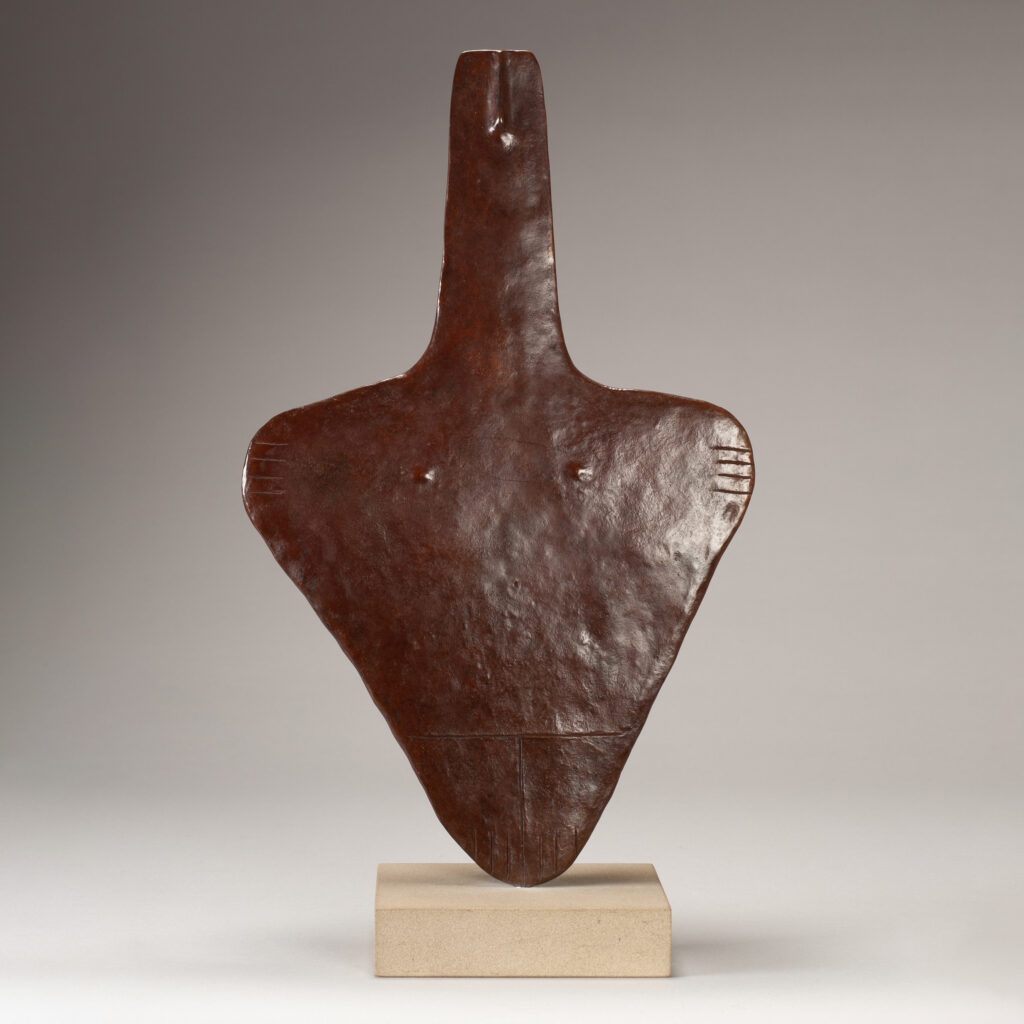
Over his career Turnbull has worked in a variety of materials, including plaster, bronze, wood, steel and plastic. Turnbull’s early work took inspiration from the sculpture of ancient Greece, West Africa and South-East Asia. His work incorporated several parts in contrasting traditional materials, such as bronze, stone and wood. From 1963–1968 Turnbull’s work was dominated by painted steel sculptures in zigzag or wavy forms.
For a few years in the early 1970s Turnbull ceased sculpting to concentrate on his paintings. After the 1973 show however, he decided to revisit his earlier sculpture ideas. Turnbull set to work making hundreds of small clay works as he worked through his ideas. In using tool-like forms Turnbull evokes the process of sculpture making and also re-evaluates tools as objects. Turnbull elevates the image of the tool to an archaeological find, something symbolic and sacred. Turnbull said ‘We now no longer look at (these shapes) in relationship to their utility, but for their sculptural quality.’
Turnbull’s bronze idols are characteristically as brightly coloured as his paintings, he often created a myriad of different coloured patinas through the edition of the same sculpture. They are also marked with low relief designs that force the viewer to get closer to read the designs, and become intimate with the sculpture.
‘Ambiguity can give the image a wide frame of reference… It creates cross-reference between something that looks like an object and that looks like an image. For me in making sculpture there is always that tension between the sculpture as object and the sculpture as image. I think it is quite different from the intention of naturalistic sculpture.’ – William Turnbull.

 English
 Chinese