
Maximilien-Louis Fiot was born in Le Grand-Pressigny, France on the 22nd of January, 1886. He began an apprenticeship under the sculptor Prosper Lecourtier, who in turn had studied under Frémiet and had pursued a career as an Animalier sculptor, dogs being his principal speciality. Fiot's first appearance at the Salon des Artistes Français was in 1904, aged just eighteen, where he exhibited a plaster sculpture of a dog. At this time he was living in Nogent-sur-Marne, a village in the countryside just outside Paris, an area much favoured by Impressionist painters, from whom he probably gained his inspiration for working in a more impressionistic style. The following year he was awarded a medal of honour, followed by a bronze medal in 1911 and a silver medal in 1913.
Maximilien-Louis Fiot was born in Le Grand-Pressigny, France on the 22nd of January, 1886. He began an apprenticeship under the sculptor Prosper Lecourtier, who in turn had studied under Frémiet and had pursued a career as an Animalier sculptor, dogs being his principal speciality. Fiot’s first appearance at the Salon des Artistes Français was in 1904, aged just eighteen, where he exhibited a plaster sculpture of a dog. At this time he was living in Nogent-sur-Marne, a village in the countryside just outside Paris, an area much favoured by Impressionist painters, from whom he probably gained his inspiration for working in a more impressionistic style. The following year he was awarded a medal of honour, followed by a bronze medal in 1911 and a silver medal in 1913.
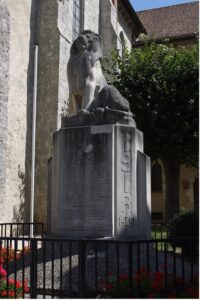 Maximilien Louis Fiot, War Memorial
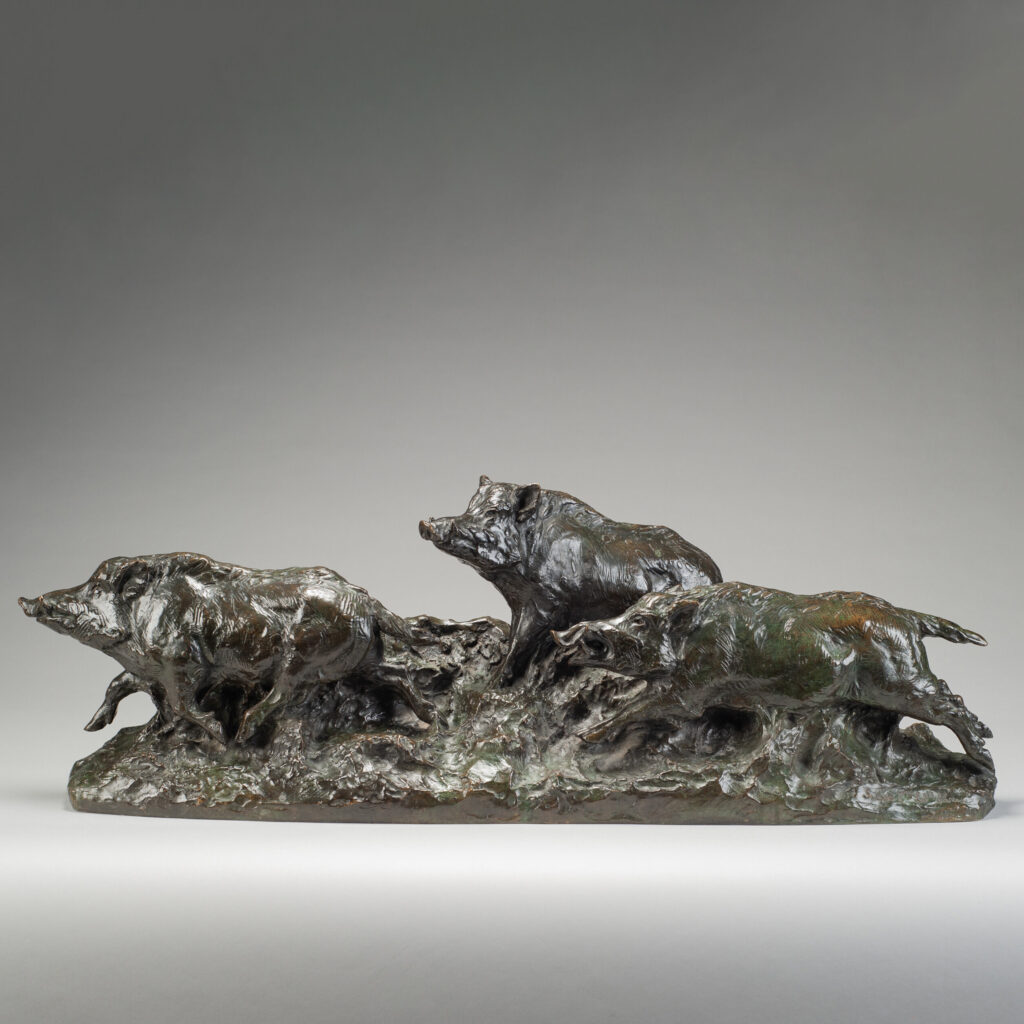
At the end of the First World War, Fiot was living in Montparnasse. The town of La Ferté-Alais, where he had previously lived, commissioned him to complete its war memorial, for which he modelled a lion that the practitioner Jules Menet reproduced in marble. He exhibited solely at the Salon des Artistes Français, becoming a member in the 1920s. He modelled horses—he won a Prix de Longchamp in 1921—and the wild animals native to the French forests, including his group Sangliers and a Faon de biche exhibited at the Salon of 1928.
Although the majority of his work was reproduced in bronze by the Susse foundry using the lost wax process, he also cast some original terracottas, which were possibly preparatory studies for his stone pieces such as Le Maquisard and Sanglier. His animals often feature in pairs: a group of two panthers entitled Prélude was bought by the city of Paris in 1932, followed by a bronze of a Biche in the mid-1930s. He also produced several decorative pieces including bookends, which provided further opportunities for creating pairs. At the 1933 Salon he won a gold medal, placing him hors concours—that is, ineligible to compete in future competitions. He continued working until his death in 1953 in Corbeil-en-Essonne.

 Chinese
  English